
Executive Summary
For most of the last decade, the post-college career script had one line in it: get into tech, or settle for less. That script is out of date. U.S. tech companies have cut more than 400,000 jobs since late 2022, and AI is now eating the entry-level roles new graduates used to rely on to get a foot in the door. Meanwhile, an industry most graduates have never seriously considered — building materials — is short on workers, structurally essential, and quietly offering faster paths to six-figure income than almost anywhere else a 22-year-old can start.
This is not construction. Nobody here is pouring concrete or climbing scaffolding. It's the marketing, sales, supply chain, finance, IT, engineering, and design work behind the materials that go into every building around you — a U.S. market worth $145 billion in 2024, growing to $196.1 billion by 2032 (P&S Market Research). It runs on the same college majors tech does. It's just been invisible to the people who'd benefit most from finding it.
This isn't a fallback plan. It's a different, better-supported bet.
Key Facts at a Glance
- U.S. tech companies have cut over 400,000 jobs since late 2022 (Crunchbase News).
- The U.S. building materials market: $145 billion in 2024, headed to $196.1 billion by 2032 (P&S Market Research).
- 83% of building materials distributors call labor shortages a top-3 operational challenge (NAW, 2025).
- Five documented entry-level roles in this industry reach six-figure total compensation within five years.
- Companies in the industry promote from within roughly 70% of the time.
Table of Contents
- The Story You Didn't Ask to Be In
- What "Building Materials" Actually Means (It's Not What You Think)
- The Bet That Flipped
- The Kind of Stable That Doesn't Trend
- The Thing You Can Actually Point To
- Every Major Has a Door Here
- The Unglamorous Math That Gets You to Six Figures
- You're More Qualified Than You Think
- What to Actually Do Monday Morning
- The Questions You're Asking
- One Last Thing
1. The Story You Didn't Ask to Be In
Zach Taylor started his computer science degree at Oregon State in 2019, back when the field still looked like a guaranteed ticket somewhere good. By the time he graduated in 2023, the market had already turned under him. In the two years since, he's applied to nearly 6,000 jobs, landed 13 interviews, and received zero offers — and, in a detail almost too on-the-nose to be real, he was turned down for a job at McDonald's for lacking enough experience.
He's not an outlier. A computer science professor at UC Berkeley posted on LinkedIn that even his top students — the ones with a 4.0 GPA in their major — were reaching out to him worried, because for the first time in his career they were getting zero offers instead of multiple appealing ones. These are not people who did anything wrong. They followed the instructions exactly, and the instructions turned out to be outdated.
Meanwhile, there's a different story that never goes viral, because nobody's posting a screenshot of it. Somewhere in that same graduating class is someone who studied marketing or supply chain and took a job at a company that makes insulation, or drywall, or composite decking and felt a little embarrassed about it at the time, like they'd settled. According to the compensation data later in this piece, that person is now on track to out-earn most of their CS-major friends inside five years, in an industry that's actively short on people and promoting them faster to keep them.
That's not a coincidence. It's a pattern, and once you see it, it's hard to un-see.
The question every graduating senior thinks they're asking is "how do I get a job in tech?" That was never actually the question. It's the answer they were handed before they had a chance to ask anything themselves. The real question is closer to: how do I build a career that won't get pulled out from under me, that does something I can point to, and that doesn't take fifteen years to go anywhere?
Deloitte's 2025 Global Gen Z Survey (23,482 people, 44 countries) put numbers to that question. 48% of Gen Z report feeling financially insecure, up from 30% the year before. More than half live paycheck to paycheck. Only 6% say their main goal is reaching a leadership title. Meanwhile 70% are actively building new skills every week, on their own time, without being asked.
That's not a generation chasing comfort. It's a generation that got burned chasing prestige and switched to chasing stability instead.
Nobody built them a map for where to find it. This is that map, and it points somewhere nobody's looking.
2. What "Building Materials" Actually Means (It's Not What You Think)
Say "building materials" out loud while you’re out with friends and watch what happens to their faces. They picture a guy in a hard hat pouring concrete. Maybe a lumber yard. Somebody's uncle who does drywall.
None of that is what we're talking about.
You will not be framing houses. You will not be running electrical conduit or standing on a roof in July. This is the industry that designs, engineers, manufactures, markets, sells, finances, and distributes the actual materials — from structural lumber and gypsum board to smart thermostats, spray foam insulation, and composite decking that's supposed to outlast the house it's on. It's the commercial machine standing behind construction, not construction itself.
That machine runs almost entirely on high level work. Marketing. Sales. Supply chain. Finance. HR. IT. Data. Sustainability strategy. Product design. E-commerce. Every function that also exists inside a tech company exists here — aimed at a different kind of product.
A marketing grad can run digital campaigns for a flooring manufacturer. A supply chain grad can route lumber shipments for a national distributor. A finance grad can model returns on a sustainable insulation line. An IT grad can build the sensor network inside a smart factory. A design grad can develop the next material that makes a house cheaper to build and cheaper to heat.
None of it requires a hard hat. Most of it happens at a desk, with a laptop, in a building that looks exactly like the one you were picturing when you imagined "the tech job."
So the actual question was never whether you'd end up behind a desk. It's what the work behind that desk builds. One version optimizes a scroll rate. Another version helps a family afford a roof that doesn't need replacing in five years. Same desk. Very different weight.
Here's where I have to be honest with you about the market-size number, because most articles like this one throw out a tidy trillion-dollar figure and move on, and I don't trust those numbers and neither should you. Research firms can't agree on what counts as "building materials" versus raw construction inputs like cement and aggregate, so global estimates for 2025 range anywhere from around $900 billion to over $1.5 trillion, depending on who's counting and what they're counting. That spread should tell you something: this is a genuinely enormous, fragmented industry, not a clean line you can look up once and quote forever. The number that holds up under scrutiny is the U.S. one — $145 billion in 2024, on track for $196.1 billion by 2032, confirmed independently by more than one research firm. That's the number worth remembering.
3. The Bet That Flipped
None of this is an argument against tech. Long-term demand for AI, cybersecurity, and cloud infrastructure skills isn't disappearing. This is an argument about risk, specifically, that the entry-level version of that bet stopped paying off the way it used to.
The numbers, briefly, because they matter: U.S. tech companies cut roughly 95,000 jobs in 2024 and over 127,000 in 2025, stacked on top of around 300,000 cuts in 2022 and 2023 — north of 400,000 total since late 2022 (Crunchbase News). Entry-level tech postings on Indeed were down 36% from pre-pandemic levels by mid-2025, with software engineering postings specifically down 49%. A Stanford study found employment for developers aged 22 to 25 fell almost 20% from its 2022 peak. What used to require zero to one year of experience now routinely asks for two or three, and entry-level pay has dropped 10 to 15% from its 2022 high.
The part that should actually worry a new graduate: it's not just that fewer jobs exist. It's that AI is specifically eating the junior rung of the ladder. The roles people used to climb through on the way to something senior are vanishing. Over 10,000 U.S. job cuts in the first seven months of 2025 were tied directly to AI automation, concentrated at entry level. Sixty percent of business leaders surveyed by Resume.org in 2026 expect layoffs this year, and 40% are planning AI replacements specifically.
That's not a cycle. That's a structural shift in what the first few years of a tech career look like.
Meanwhile, over in building materials, nobody's trying to automate the branch manager who's kept a regional distributor's inventory from collapsing for eleven years, and nobody's building an AI to walk a contractor through which composite decking actually survives a Minnesota winter. The work is different enough, and physical enough, that it hasn't become a target the same way.
That's the whole paradox in one sentence: the industry that got sold to you as ambitious became risky, and the industry nobody put on a vision board became one of the more dependable bets left standing.
4. The Kind of Stable That Doesn't Trend
Here's a fact so boring it barely registers, and that's exactly why it works: people always need shelter. Buildings always age. Somewhere, right now, a school district is finding out its roof needs replacing before the money's actually approved for it. None of that is optional, seasonal, or subject to whatever's trending this quarter.
That's the entire case for stability here. It isn't exciting. It's structural.
Roughly 52% of U.S. material demand ties directly to residential construction and remodeling. And the fastest-growing slice of the market isn't new construction, it's renovation and repair, growing at nearly a 5% annual clip, because old buildings don't stop aging just because new-home starts slow down. That matters more than it sounds like it should: it means the demand under this industry doesn't vanish the moment the broader economy gets nervous. It just shifts from building new things to fixing old ones.
Then there's the part that works entirely in your favor if you're 22 and looking for an opening: the Bureau of Labor Statistics projects over 142,000 annual job openings for wholesale and manufacturing sales reps through 2034 — and most of those exist because the current workforce is aging out, not because the industry is expanding fast. The average worker in this field is over 40. In a 2025 survey, 83% of distributors named labor shortages one of their top three operational headaches.
Read that as what it actually is. An industry that can't find enough people isn't a warning sign for you. It's leverage. Nobody in a labor shortage is going to make you wait five years to prove yourself.
5. The Thing You Can Actually Point To
There's a specific ‘flatness’ that shows up in a lot of early-career tech and marketing work, and it's rarely about the paycheck. It's about not having anything to point to.
You optimized a funnel. You bumped an engagement metric by some percentage that got forgotten by the next sprint. You shipped a feature that got deprecated eight months later when the roadmap changed. None of that is fake work. But none of it is something you can drive past twenty years from now with your own kid in the car and say, "I helped make that."
This industry runs on the opposite kind of output. The insulation you helped market is keeping a specific family warm tonight. The composite cladding you priced out is cutting the carbon footprint of an actual building with an actual address. The supply chain you fixed got materials to an affordable-housing project on schedule instead of six weeks late.
That's not a coincidence with what this generation says it wants. 89% of Gen Z say purpose matters to their job satisfaction. 40% have already quit something that didn't have any. And this industry happens to sit right on top of two things this generation cares about loudly and often: the affordable-housing shortage, and the shift toward materials that don't cook the planet while they're being made. Material scientists are building products that are lighter, cheaper, and less carbon-intensive. Sustainability leads are designing net-zero building systems. That's not a side initiative with a nice logo. It's becoming the actual core of how the industry competes.
6. Every Major Has a Door Here
This isn't one career path in Building Materials. There is a whole cluster of them, and there's a version for almost every major sitting in a lecture hall right now.
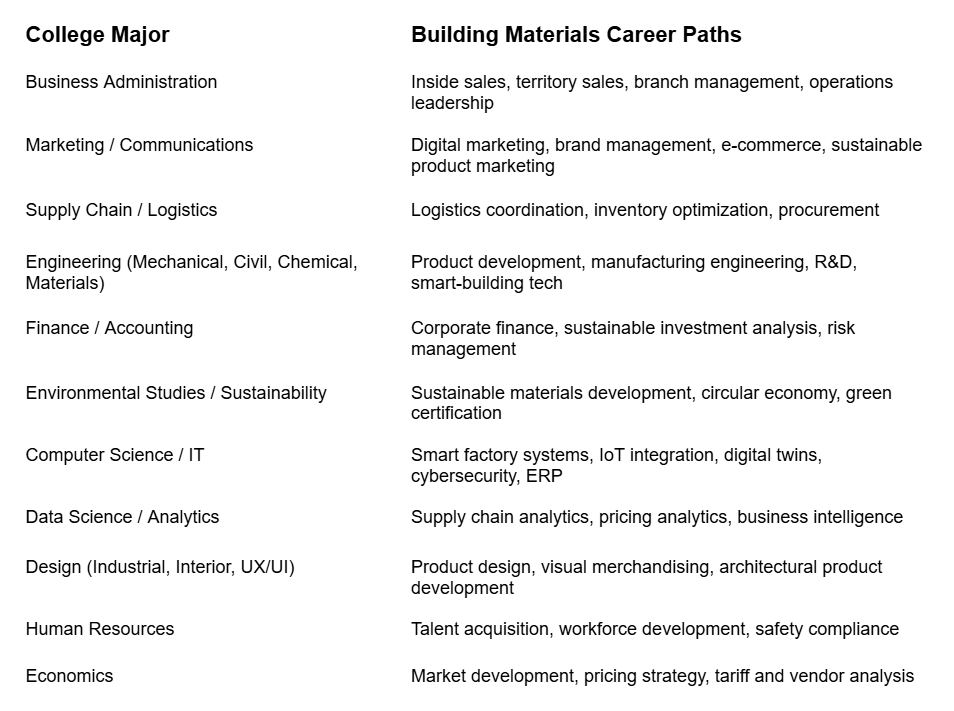
Roles split two ways, roughly. Manufacturer-side puts you closer to product development, engineering, and corporate marketing. Distributor-side puts you closer to branch management, inside sales, and supply chain. Both sides are hiring, and most of these jobs don't require a background in the industry at all — companies actively recruit out of retail, logistics, and general sales, because the product knowledge gets taught on the job. What doesn't get taught on the job is judgment, communication, and the willingness to learn, and those you presumably already have or you wouldn't have made it through a degree.
E-commerce, digital marketing, and IT are the fastest-growing corners of the industry right now, as it works through its own version of a digital overhaul — smart factories, IoT sensors, and data analytics that were optional five years ago and are close to standard now.
7. The Unglamorous Math That Gets You to Six Figures
Here's where this stops being about values and starts being about arithmetic.
The labor shortage from Section 4 doesn't just create openings. It compresses timelines. A company that can't find enough people doesn't make the people it does find wait five years to prove themselves — it moves them faster, pays them more, and builds an actual pathway to keep them from walking.
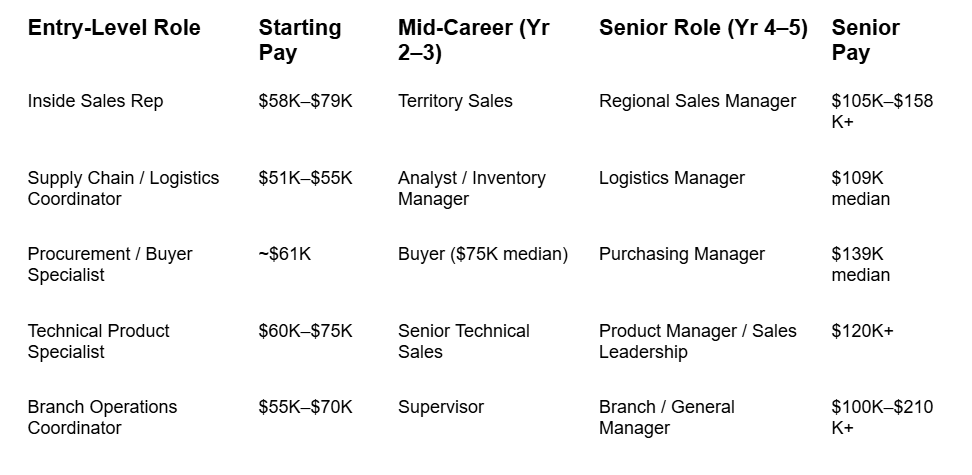
Companies in this industry promote from within about 70% of the time. That's not a perk, it's a sign that trust moves faster internally than an external hiring process ever could. Certifications compress the timeline further: supply chain credentials like ASCM's CSCP or CLTD carry an 18 to 20% pay premium and can shave a year or more off the climb to six figures. OSHA 30 is close to mandatory for anyone being considered for branch management.
Salaries industry-wide grew 4 to 6% year-over-year into 2026, at a moment when entry-level tech pay has gone the opposite direction. Housing demand, infrastructure spending, reshored manufacturing, and the shift to sustainable products are all adding complexity that this industry needs skilled people to manage, and managing complexity, historically, is exactly what gets a 24-year-old promoted ahead of schedule.
8. You're More Qualified Than You Think
Somewhere along the way, Gen Z got told its skills don't count as real skills. Scrolling isn't a résumé line. Growing up online isn't a qualification. That was never true, and this industry is a pretty clean counterexample.
An industry running ERP platforms, CRM systems, dashboards, and digital-twin software doesn't treat digital fluency as a bonus, it treats it as the baseline, and most 22-year-olds clear that bar without trying.
The instinct for social content maps directly onto the digital marketing and e-commerce roles this industry is actively short-staffed on. Comfort with data translates straight into pricing analytics and supply chain forecasting. Years spent as a customer inside fast, frictionless e-commerce builds exactly the instinct that shows up in sales and customer success work.
And the generation that gets mocked for "job hopping" turns out to be the most consistently self-taught one on record — 70% building new skills weekly, 67% doing it on their own time. An industry that's rebuilding itself around digitalization and sustainability doesn't need people who already know everything about lumber grading. It needs people who keep learning after the diploma. That's not a soft trait to work around. It's the actual hiring bar.
9. What to Actually Do Monday Morning
None of the above matters if it stays a nice idea, so here's the version of this story that you can act on this week:
- Check the job board. BMCANA's board at buildingmaterialscareer.com lists current openings in sales, marketing, supply chain, engineering, IT, and finance.
- Look for structured programs. Companies like Beacon Building Products run management development programs built for new grads, with cross-functional training and a real line to leadership.
- Get certified early. ASCM's CSCP or CLTD, or ISM's CPSM, can add an 18–20% pay premium and shorten your path to six figures.
- Talk to people two rungs up. Reach out on LinkedIn. This industry turns out to be more accessible than people assume.
- Fix your LinkedIn keywords. "Inside sales building materials" and "supply chain coordinator" are what recruiters actually type into the search bar.
- Research locally. Look at manufacturers and distributors near you, and decide whether sustainability-focused, tech-forward, or large-scale operations fit what you want.
- Lead with what transfers. Project management, analytical thinking, communication, and any customer-facing job you've ever worked matter more here than direct industry experience.
- Look at where the growth actually is. Texas, the Mountain West, and the Pacific Coast currently pay structurally higher, and relocation packages and signing bonuses are becoming more common.
10. The Questions You're Asking
Is this the same as construction? No. You'd be in an office, a showroom, a plant, a distribution center, or working remotely — not pouring concrete or framing a house.
Do I need a trade background or construction experience? No. Most roles want a college degree or equivalent experience, often in any field. The product knowledge gets taught on the job, and employers regularly hire out of retail, logistics, and general business.
Can I actually work in marketing or tech here? Yes — the industry employs digital marketers, e-commerce specialists, developers, data analysts, and cybersecurity people as it works through its own digital overhaul.
Is this stable, or just tied to the housing market? It's driven by several forces at once — new construction, renovation, infrastructure spending, and the shift to sustainable materials — so it doesn't rise and fall with any single one. Renovation demand in particular keeps growing even when new construction slows.
Is the advancement speed real, or just recruiting copy? It's sourced from Bureau of Labor Statistics data, Glassdoor, ZipRecruiter, and 2026 industry placement data — not projections the industry made up about itself.
Is this only for business majors? No. Marketing, IT, HR, finance, supply chain, sustainability, engineering, and design all exist here. Your major matters less than whether you're willing to learn the product.
Will I get paid less than in tech? Entry-level pay here, generally $51K–$79K, is comparable to or better than a lot of entry-level tech offers in 2025–2026, which have dropped 10–15% from their 2022 peak. The bigger gap is in the trajectory — senior roles like purchasing manager ($139K median) or branch/general manager ($100K–$210K+) are competitive with mid-career tech pay, and they're reachable sooner.
11. One Last Thing
The old question was tech or nothing. That was never actually the choice — it just felt that way because nobody was offering an attractive enough alternative to hear over the noise.
The real question is where you can build something stable, something that means something, and something that actually moves. This industry answers all three, not because it's exciting, but because it's essential, and essential doesn't need to be exciting to be worth betting on.
The labor shortage driving all of this isn't a problem for the industry. It's an opening for you. These companies aren't waiting around for a perfect candidate with five years of niche experience they can't get anywhere else. They're promoting faster and paying more because they have to.
You don't need to know anything about insulation or gypsum board to start. You need curiosity, a few skills that transfer, and the willingness to learn an industry that's changing as fast as any tech company — just with a longer memory.
Visit buildingmaterialscareer.com. Follow BMCANA and message someone on LinkedIn who's two steps ahead of where you want to be. Your first job doesn't have to be your last one. It just has to build something real.