
How AI Is Creating New Careers in the Building Materials Industry
Table of Contents
- Quick Take
- The Job Nobody's Competing For
- The Skills Gap Nobody's Filling
- Sales: The Number Aren’t the Job
- Marketing: From Getting Seen to Getting Specific
- Design: Where Everything Actually Collides
- Distribution: The Judgment That's Left Over
- Where the New Roles Are
- Why This Beats the Obvious Choice
- What Employers Need to Actually Do
- What to Do About It
- The Point
- FAQ
Quick Take
- AI is already live and growing in building-materials sales, marketing, design, and distribution — not piloted, running.
- McKinsey: AI can cut distributor inventory 20–30%, logistics costs 5–20%.
- WEF: a net 78 million new jobs globally by 2030; AI and big data are the fastest-growing skill category.
- U.S. wholesale distribution alone employs 6M+ people and drives roughly a third of GDP (NAW) — and almost nobody AI-literate is applying.
The Job Nobody's Competing For
You've spent your whole career overlooking building materials.
So has everyone else you're competing with.
Earlier this year, US LBM, one of the largest building-products distributors in the country in America, plugged an AI estimating tool into its workflow. Feed it a floor plan, get a materials takeoff back in minutes. No press tour. Just a company most people have never heard of, quietly automating a job that used to eat an estimator's afternoon.
Quick clarification for the uninitiated: building materials isn't construction. No hard hats, no job sites. It's the design, manufacturing, marketing, and distribution of what every building project needs — lumber, insulation, roofing, millwork. A commercial industry sitting behind the one you're picturing. Employing six million people, and generating a healthy slice of North American. GDP.
Nobody markets careers in it, which says everything about the industry's branding and nothing about its economics.
And it means the AI-literate people flooding into tech and finance and whatever else right now are ignoring one of the largest employers in the country.
The Skills Gap Needs Filling
Ninety-four percent of business leaders say they can't find people with the AI skills they need. A third say the gap runs past 40 percent, less a hiring crisis than a door standing open that almost nobody's walked through yet.
The World Economic Forum ranks AI and big data as the fastest-growing skill category through 2030 — and 85% of employers say they're already planning to upskill their people rather than replace them. Building materials is one of the industries acting on that fastest, because it has no other option. The estimators, quoting specialists, and warehouse managers it needs don't grow on trees, and the industry can't outsource the problem to Silicon Valley.
Sales: The Numbers Aren’t the Job
A rep used to spend the week doing takeoffs by hand, then send a quote and hope. Now the software does the takeoff. Graybar runs an AI quoting platform called Parspec. Vendors report faster, more accurate quotes since tools like it showed up.
Nobody's writing about what happens next: the rep who now has four extra hours a week and a relationship to build instead of a spreadsheet to fill out.
Relationships were always the harder half of the job — the part reps rarely had time to actually do well.
Marketing: From Getting Seen to Getting Specific
McKinsey watched a building-materials distributor use generative AI to write personalized marketing emails straight from lead data. Nothing clever about the technology.
What's clever is what happened next and what it replaced: a marketer guessing what a contractor might want to hear, multiplied across a thousand contractors, all sounding the same.
Most marketing teams here are still optimizing for reach, in a moment that's started rewarding specificity instead.
Design: Where Everything Actually Collides
This is the part of the industry nobody outside it thinks about. It's also the part with the most leverage.
Specification — deciding exactly what product goes where — sits at the one point where a customer's need, a product's spec sheet, and a sales quote all have to agree. AI tools now turn a 2D floor plan into a 3D model with a takeoff tied to real, purchasable inventory. This order, in the hands of an AI savvy employee, is basically built already and just waiting on a signature.
If you want the seat where product, sales, and customer all meet at once, this is it.
Distribution: The Judgment That's Left Over
McKinsey's numbers here are the most eye catching in the industry: up to 30% less inventory, up to 20% lower logistics costs, real warehouse capacity freed up without adding square footage.
QXO is running warehouse robotics and route optimization. Other distributors are using demand forecasting to decide where to open the next branch, instead of asking a regional manager to guess.
What a warehouse manager does all day is shrinking down to the one thing the software still can't do: knowing when the forecast is wrong.
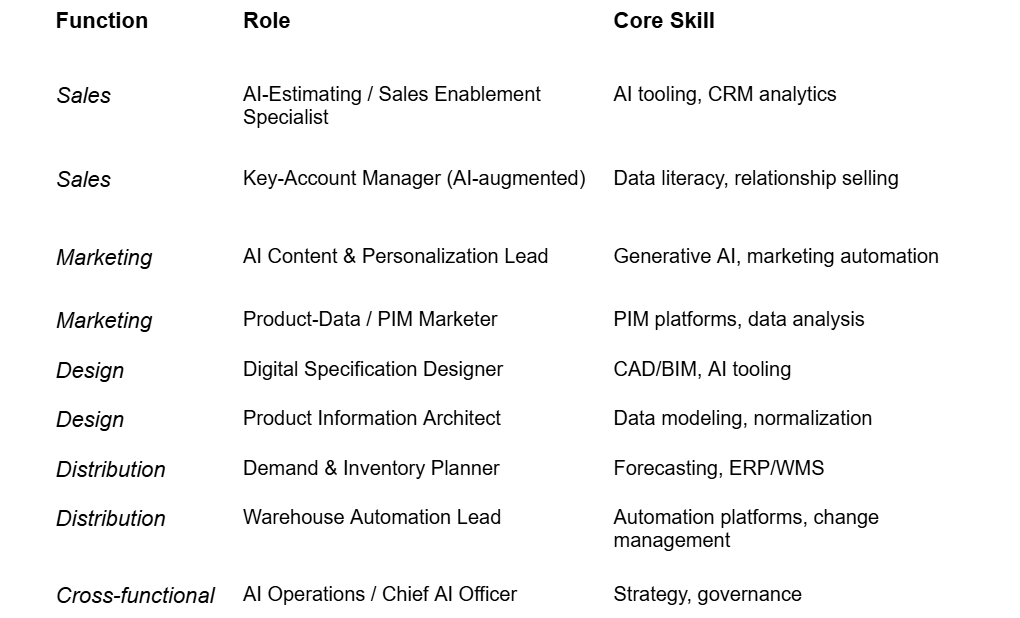
Where the New Roles Are
Why This Beats the Obvious Choice
In tech, AI fluency makes you one of ten thousand qualified applicants. Here, it makes you one of very few, simply because so few thought to look.
The demand floor doesn't move. Materials and shelter aren't optional, in a way most product categories wish they could claim. And the industry is what analysts call a technological fast follower: early adopters here keep their edge instead of getting drowned out by twenty competitors doing the same thing a month later.
Get in now and you help decide how this plays out. Wait five years and you inherit someone else's decisions.
What Employers Need to Actually Do
Redesign roles so AI supports the people already doing the work. NAW's human-centered AI framework, developed with the AI Applied Consortium, is explicit about the goal: building skill and trust rather than cutting headcount.
Upskill the people already on staff — 77% of employers already plan AI training. Hire for the blend of data fluency and product knowledge over a pure software background; a good estimator willing to learn a tool beats a great coder who's never seen a takeoff.
Start with one or two use cases that pay off fast. Reinvest what they save into the people doing customer-facing work. Distributors that do this tend to grow their headcount — the opposite of what most people assume walking in.
What to Do About It
If you're looking for work:
- Pair AI-tool fluency with real industry knowledge — specification, distribution fundamentals, how a quote actually moves. The combination is rare.
- Start in estimating technology, sales enablement, marketing analytics, demand planning, or product-data management.
- Ask employers if they have an active AI roadmap. If they don't, that's your answer.
If you're hiring:
- Ship one visible AI win in three to four months. Momentum beats a five-year plan.
- Put your AI governance approach in writing, not just a slide.
- Reward managers who reinvest productivity gains into people, not just margin.
The Point
Everyone assumes the safe move is chasing the industry everyone else is already excited about.
That's exactly what makes it crowded, slow to promote you, and hard to stand out in.
The people this industry is actually short on are the ones who understand a supply chain well enough to point a tool at the right problem — a narrower skill than knowing Python, and in much shorter supply.
Overlooked is another word for available.
FAQ
Is building materials the same as construction? No. It's the design, manufacturing, marketing, and distribution of what construction uses — a B2B industry, not on-site trade labor.
Will AI cut jobs in Building Materials? The data says the opposite: distributors that reinvest AI-driven savings into customer-facing roles tend to grow headcount.
Do I need to code? No. AI-tool fluency and industry knowledge matter more than software engineering for most of these roles.
Why this industry over tech or finance? Less competition for the same AI skills, real leverage in a sector still catching up, and demand that doesn't disappear in a downturn.