
Executive Summary
Building materials is a product and supply-chain industry, not a construction-site industry — therefore the certifications that actually move a career here don’t look like the ones construction workers carry.
What you will come to understand is a single point: a certification only has value when it solves a problem the employer already has — winning a specification, cutting compliance risk, closing a documentation gap, opening a new market. It walks through the credentials worth pursuing by career path (ISO 9001 and Lean Six Sigma for manufacturing and quality; LEED, EPD, and life-cycle-assessment training for sustainability and specification support; buildingSMART's openBIM credentials for digital product data; product and specification training for technical sales), flags the certifications that tend to be a waste of tuition, and lays out how to turn any of them into a resume line an employer actually believes.
Table of Contents
- The Credential That Didn't Work
- The Test That Actually Matters
- Best Certifications by Career Path
- Sustainability Credentials: LEED, EPD, and the Data Problem
- Quality and Manufacturing: ISO 9001, Lean Six Sigma
- BIM and the New Definition of "Knowing Your Product"
- Sales and Specification: Selling Without Selling
- The Certifications Worth Skipping
- Choosing Your Credential
- Putting It on a Resume Without Lying
- The 90-Day Plan
- Frequently Asked Questions
1. The Credential That Didn't Work
There's a quality manager somewhere in this industry — you probably know one — who spent four years collecting certificates. ISO 9001 internal auditor. A Six Sigma green belt. Two vendor-specific training programs she barely remembers now. She hung them on her office wall like a kid hangs up soccer trophies as proof, mostly to herself, that she was good at this.
Then a promotion she wanted went to someone with half her paperwork.
She was furious for about a week. Then she asked the plant director why, expecting an awkward conversation about politics. Instead he said something that annoyed her more than any excuse could have: "He fixed the returns problem in Building 3. You have more letters after your name. He has a number that used to be bad and now isn't."
What tends to sting for many in a story like this one is that she wasn't wrong to get certified. She was wrong about what the certificate was for.
The credential was never the proof. It was supposed to be the tool. She'd been polishing the tool instead of using it.
This is the trap almost everyone in building materials falls into at some point, because it's a genuinely confusing industry to build a resume for. It's not construction. Nobody's handing out hard hats. It's the world behind construction — and in an industry that is as broad and yet, as specific as this one, it's tempting to think a certificate will speak for you.
But it won't. Not by itself. But it can, if you use it the right way, as a tool aimed at someone else's actual problem, not a trophy aimed at your own insecurity.
And that’s the point. What you’ll find below is the specifics.
2. The Test That Actually Matters
Most job seekers in this industry waste their first certification on a version of the wrong question. They ask "what will make me look qualified?" instead of "what does this specific employer already need done?" A general contractor's safety card doesn't mean much to a plant manager reviewing supplier audits. A trade license doesn't help a product marketer writing sustainability copy. Those aren't wrong certifications. They're just answers to a question nobody in this industry is asking.
The right question is simpler, and it costs nothing to ask before you spend a dollar or an evening on anything: whose problem does this actually solve?
Not yours. Theirs. The employer's.
A certification earns its cost when it does one of these things — qualifies you for a role that's currently open, helps a company win a specification, cuts compliance or quality risk, cleans up product documentation, or gets a customer to trust you faster.
If you can't name which one it does for a specific job you want, you're not building a career. You're collecting merit badges nobody asked you to earn.
3. Best Certifications by Career Path
Relevance beats prestige, every time. The most recognized certification in the world is worthless if it's solving a problem nobody in your target role actually has. Here's roughly how it breaks down by path — treat this as a starting map, not a shopping list.
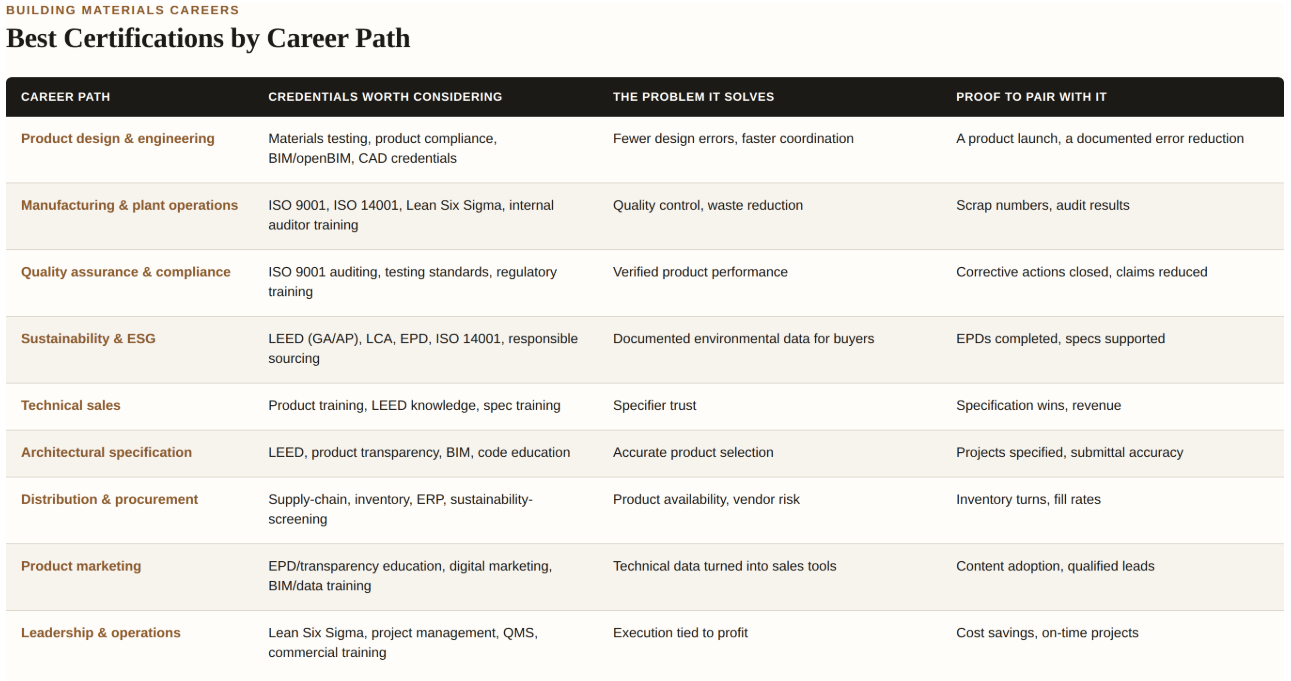
Notice what's not in that table: a column for "sounds impressive." That column doesn't exist for a reason.
4. Sustainability Credentials: LEED, EPD, and the Data Problem
Here's a paradox that is worth a few minutes of consideration. The people who benefit most from sustainability credentials are often nowhere near a construction site, and nowhere near what most people picture as "sustainability work." They're sitting with a spreadsheet in front of them, chasing down a supplier for carbon data, trying to get a life-cycle assessment to make sense before a customer's deadline.
Glamorous, it is not. Valuable, it absolutely is.
LEED Green Associate gives you broad, foundational knowledge of how green building works. LEED AP goes deeper into a specific rating-system area. Neither one certifies a product. Neither one guarantees a job. What they do is give you a shared language with the architects and specifiers who are increasingly the ones deciding which products get used, and increasingly asking questions your untrained sales team can't answer.
An Environmental Product Declaration, or EPD, is quantified environmental data about a product, verified by a third party, based on a life-cycle assessment. You don't need to become the scientist who runs that assessment. You need to be the person who can coordinate it, chase the supplier data, manage the categories, and keep the verification on schedule. That person is unusually hard to find and unusually valuable once found.
ISO 14001 covers environmental-management systems, and it matters most in manufacturing and compliance roles doing audits and waste tracking.
Before you commit to any of this, ask three honest questions.
- Does your target employer's product actually require environmental documentation?
- Do their customers ask for it, or is this a credential in search of a use case?
- And does the training teach you to interpret data, or just to recognize the acronyms?
If it's the acronyms, keep your money.
5. Quality and Manufacturing: ISO 9001, Lean Six Sigma
There's a version of quality certification that's genuinely useful, and a version that's a laminated piece of paper. The difference isn't on the exam either, it's what happens after.
ISO 9001 training is strong for quality managers, plant managers, and internal auditors, but the certificate itself doesn't fix a single nonconformance report. What fixes it is someone who's done root-cause analysis, run a supplier audit, and closed a corrective action loop. The certification is the vocabulary. The experience is the fix.
Lean Six Sigma works the same way. A belt color means nothing on its own. A documented project — less scrap, fewer damaged shipments, a warehouse that stopped losing time to bad picking — means a lot. Employers have seen enough green belts who can define "Six Sigma" and can't point to a single number they moved.
One more thing, because it trips people up all the time: safety training should match where you actually work. A plant, a lab, a warehouse, a showroom. Not a construction site. Bringing a general contractor's safety card to a manufacturing interview is like bringing a driver's license to a pilot job. Related field but the wrong credential.
6. BIM and the New Definition of "Knowing Your Product"
In building materials, this is crucial: knowing your product used to mean being able to describe it. Now it increasingly means being able to encode it — as a BIM object, with accurate performance data, environmental attributes, and installation requirements that a specifier's software can actually read.
This is increasingly a skill manufacturers and distributors need badly, because a product that isn't documented digitally is, for a growing number of specifiers, a product that doesn't exist.
BuildingSMART's professional certification program is built specifically to validate this kind of openBIM knowledge. Combine it with product-information management — data governance, SKU structures, digital asset management — and you’re on your way to becoming the person who makes the product usable, not just the person who can describe it in a meeting.
The proof that matters here isn't the certificate. It's a validated product family, a library of BIM objects, a measurable drop in specification errors.
7. Sales and Specification: Selling Without Selling
The best technical salespeople in this industry rarely sound like salespeople. They sound like the person who actually understands the product's limitations — which, counterintuitively, is what makes a specifier trust them enough to buy.
Generic sales training teaches persuasion. What actually works here is teaching product performance, code requirements, total cost of ownership, and specification language well enough that persuasion becomes unnecessary. Nobody needs convincing when the technical answer is already correct.
Specification-focused training, such as writing and interpreting specs, MasterFormat structure, submittal review, matters because it lets you speak the same language as the architects and engineers making the actual decision. And manufacturer-specific product training, despite having zero brand recognition on a resume, often outperforms every generalist credential you could earn, because it's aimed directly at the products your customers are buying.
8. The Certifications Worth Skipping
Not every certificate deserves your evening classes. Some warning signs are worth memorizing:
- It never shows up in job postings for the role you want.
- The issuing body is one you've never heard of and can't verify.
- The "exam" is a quiz you can't fail.
- The content has nothing to do with the job in front of you.
- The marketing promises a salary jump it can't actually back up.
The math here is that five weak certificates rarely beat one respected credential and a project you can talk about for ten minutes. Stacking initials after your name doesn't compound the way stacking money does. It just gets long.
9. Choosing Your Credential
Start with a target role, not a target credential. Technical product manager. Quality engineer. Specification manager. Product-data coordinator. Whatever it is, name it first.
Then pull fifteen or twenty real job postings for that role because they're the closest thing to a direct message from the employers you want to work for, telling you exactly what they're looking for. Read them carefully and you’ll spot the certification pattern.
Match the stage of the certification to the stage of your career. Entry level rewards fundamentals. Early career rewards one role-specific credential plus one applied project. Mid-career rewards specialization — advanced auditing, sustainability implementation, supply-chain expertise. Leadership rewards systems thinking and financial fluency more than any single credential at all.
10. Putting It on a Resume Without Lying
Compare these two lines:
"LEED Green Associate, 2026."
"Earned LEED Green Associate credential and used product-transparency knowledge to support 18 specification requests involving EPDs, recycled content, and indoor-air-quality documentation."
The first is a fact about you. The second is a fact about what changed because of you. Only one of those gets read past the first three seconds.
Credential. Application. Result. That's the whole formula. If you can't fill in the second and third parts, you don't have a resume line yet. You have a receipt.
11. The 90-Day Plan
Days 1–15. Pick one target role. Pull the job postings. Ask someone who already has the job which credential their employer actually respects and which one sounds respectable but is ultimately useless.
Days 16–30. Compare issuing bodies. Confirm the exam and renewal requirements. Do the ROI math honestly, including the time you could be spending on something else.
Days 31–60. Study — but apply what you're learning to a real problem at work as you go, not after the exam. This is the step almost everyone skips, and it's the one that actually matters.
Days 61–75. Take the exam. Prepare examples of what you've already applied, not just what you've memorized.
Days 76–90. Update your resume with the credential-application-result formula. Share the project, not just the certificate. Apply to roles where this specific credential solves a problem the posting already admitted to having.
12. Frequently Asked Questions
What certifications are best for a career in building materials? It depends on the role. ISO 9001 and Lean Six Sigma suit manufacturing and quality. LEED, EPD, LCA, and ISO 14001 suit sustainability and product-documentation work. BIM and openBIM credentials support digital product information. Specification and technical-sales training suits customer-facing roles.
Is LEED certification useful if I don't work in construction? Yes. It's useful in manufacturing, product marketing, technical sales, and specification support, because these professionals often help customers select products for projects pursuing green-building goals. It's strongest paired with real product documentation knowledge, not held on its own.
Do I need a certification to work in building materials? No. Many roles value product knowledge, experience, and measurable results more than formal credentials. A certification earns its place when it fills a documented gap for a specific role you're targeting.
Are product certifications the same as professional certifications? No. A product certification applies to a product, process, or organization. A professional certification applies to you. You can build real career value around knowing how to manage and explain product certifications without holding one yourself.
Are OSHA certifications important in building materials? Safety training matters in plants, warehouses, labs, and distribution centers — but match it to your actual workplace instead of assuming a construction-site card transfers.
What's the difference between an EPD and a sustainability certification? An EPD is quantified environmental data for a specific product, based on life-cycle assessment and third-party verification. A sustainability certification often evaluates a broader mix of environmental, health, social, and manufacturing criteria. Know exactly what each one measures before you lean on it in a conversation.
Is BIM relevant to manufacturers and distributors, not just architecture firms? Yes. They increasingly need accurate digital product information — BIM objects, performance data, environmental attributes. BuildingSMART's professional certification program exists specifically to validate that kind of openBIM knowledge.
Which certification should I get first? Whichever one shows up most often in job postings for your target role. If nothing shows up consistently, choose training that forces you to produce something real — a quality project, a product-data library, an EPD workflow.
How many certifications should I list on my resume? Only what supports the job you want. One or two credible credentials with a documented result beat a long list of unrelated ones.
Can certifications increase salary? They can open access to better roles, but no credential guarantees a raise on its own. Compensation still depends on experience, market demand, and what you can actually point to and prove.
Remember, before you sign up for the next course or credential program ask yourself this one question: whose problem does this solve, and can I prove it did?
That question will outlast every acronym on this page.