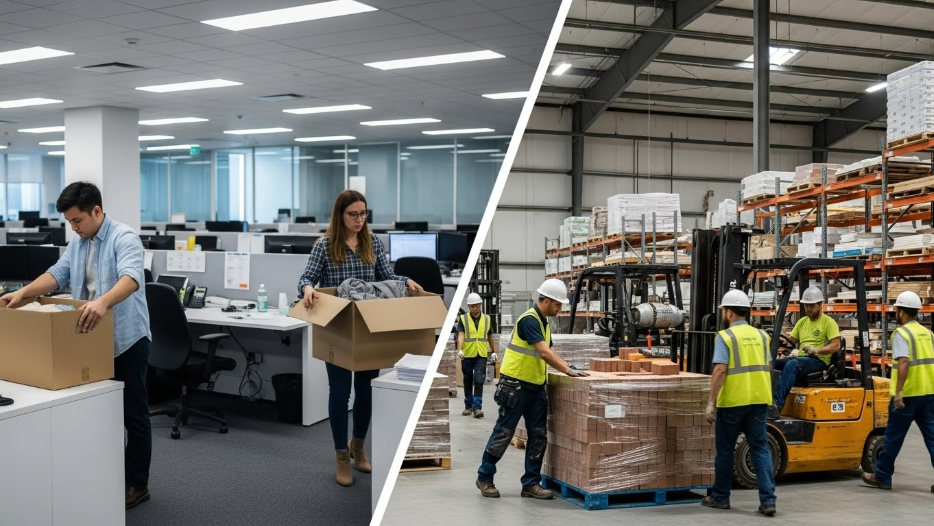
While many sectors are sheding hundreds of thousands of workers, the industry building North America's physical foundation can't hire fast enough, and it's not going to stop.
Table of Contents
- Executive Summary
- A Layoff Nation
- The Hidden Giant
- What's Fueling the Boom
- Where the Jobs Are
- Tech vs. Tools
- Career Crossovers
- Challenges to Watch
- Building the Future
- FAQs
Executive Summary
The paradox is stark. While household names announce layoffs by the thousands—Amazon cutting 30,000, Intel shedding 24,000, UPS reducing 48,000—one sector quietly absorbs workers, expands production lines, and posts job openings faster than candidates can fill them. That sector is building materials.
This isn't about pivoting to the next app or chasing another tech disruption. This is about cement plants running triple shifts, lumber mills expanding capacity, and insulation manufacturers opening new facilities across North America. The building materials industry—comprising everything from structural steel and glass to HVAC systems and smart home technologies—has become an unexpected refuge in an economy defined by volatility.
The reasons are structural, not cyclical. Governments are pouring billions into infrastructure. Housing shortages persist across major metros. Climate mandates require retrofitting millions of buildings. Supply chains are reshoring. And unlike software, you can't download concrete.
This article maps the landscape of opportunity in an industry most people walk past without noticing—one that employs millions, generates over $1.6 trillion annually in North America, and will continue expanding regardless of which way the economic winds blow.
A Layoff Nation
December 2025 delivered a gut punch to American workers. The Kobeissi Letter compiled the twenty largest layoff announcements: 307,000 federal employees, 48,000 at UPS, 30,000 at Amazon, 24,000 at Intel. The list read like a cross-section of the economy—tech giants, manufacturers, logistics firms, retailers. Even Meta, the company that promised to connect the world, cut 600 positions.
The pattern transcends any single sector. Accenture, the consulting behemoth, eliminated 11,000 roles. Salesforce, once synonymous with rapid growth, cut 4,000. Verizon reduced headcount by 15,000. These aren't struggling companies on the brink of collapse—many posted profits. They're recalibrating for an environment where efficiency matters more than expansion, where algorithms promise to do more with less, where "optimization" has become corporate gospel.
For workers, the psychological toll compounds the financial one. Career planning becomes absurd when your role might evaporate in the next earnings call. College graduates enter a market where even prestigious degrees offer no immunity. Mid-career professionals watch as the skills they spent decades building become obsolete or redundant. The social contract—work hard, add value, keep your job—has frayed.
Yet layoff announcements tell only half the story. While corporate giants shed workers, other corners of the economy are starved for labor. According to the Bureau of Labor Statistics, building and extraction occupations face some of the tightest labor markets in the country. The disconnect isn't a mystery: workers gravitate toward sectors that feel modern, digital, prestigious. Few consider the companies making insulation or producing aggregates. The result is a mismatch—mass unemployment coexisting with mass unfilled positions.
Building materials sits at the center of this paradox. While tech companies announce hiring freezes, cement manufacturers can't find enough plant operators. While retailers close distribution centers, roofing suppliers open new ones. The industry isn't immune to economic cycles, but it operates on a different frequency—one tied to physical necessity rather than market sentiment.
The Hidden Giant
The building materials industry is everywhere and nowhere. Everywhere because every structure around you—your office, your home, the bridge you crossed this morning—required tons of materials produced by this sector. Nowhere because few people think about where those materials originated, who engineered them, or how they arrived on site.
The industry encompasses establishments that innovate, design, engineer, produce, market, advertise, distribute, and sell materials for construction, renovation, and infrastructure upgrading. This includes naturally occurring substances like wood, stone, and clay, plus manufactured products like concrete, composites, laminates, and steel. It extends to roofing, insulation, plumbing, lighting, HVAC systems, fixtures, glass, flooring, and smart home technologies.
Scale matters. North America's building materials sector generates over $1.6 trillion annually and employs millions across manufacturing, distribution, logistics, sales, and engineering. Yet it remains invisible to most job seekers. College career centers rarely promote opportunities in cement manufacturing. LinkedIn algorithms favor software engineers over quality control specialists at glass plants. The industry suffers from an image problem—it's seen as old economy, unglamorous, manual.
This perception is outdated. Modern building materials companies operate sophisticated supply chains, employ advanced manufacturing techniques, and invest heavily in sustainability R&D. A structural engineer at a steel manufacturer might use AI-powered design tools. A logistics coordinator at a distribution center manages real-time inventory systems. A sustainability specialist develops low-carbon concrete formulations. These aren't your grandfather's factory jobs.
The invisibility creates opportunity. When everyone chases the same narrow set of careers, competition intensifies and stability declines. Building materials offers the opposite: high demand, lower competition, and roles that can't be outsourced to cheaper labor markets or automated away by the next software update.
What's Fueling the Boom
Three forces converge to drive unprecedented demand for building materials: government investment, housing scarcity, and climate imperatives.
Infrastructure Renaissance
The U.S. Infrastructure Investment and Jobs Act allocated $1.2 trillion for roads, bridges, water systems, and broadband. Canada's National Infrastructure Assessment identified $1 trillion in needed investments over the next decade. These aren't abstract budget lines—they translate directly into demand for concrete, steel, aggregates, and specialized materials. Every mile of highway requires tons of asphalt and concrete. Every bridge rehabilitation needs structural steel. Every water system upgrade demands pipes, valves, and treatment equipment.
State and provincial governments are simultaneously addressing decades of deferred maintenance. The American Society of Civil Engineers grades U.S. infrastructure at C-minus, noting that one in three bridges requires repair or replacement. Closing this gap will consume materials—and workers—for decades.
Housing Crisis
North America faces a severe housing shortage. Canada needs 3.5 million additional homes by 2030 to restore affordability, according to the Canada Mortgage and Housing Corporation. The U.S. is short approximately 4 million units, per Freddie Mac estimates. Building millions of homes requires lumber, drywall, insulation, windows, roofing materials, HVAC systems, plumbing fixtures, and flooring—all produced by the building materials sector.
The shortage isn't temporary. Zoning reforms are gradually increasing buildable land. Interest rates, while elevated, will eventually normalize. Demographic pressures from millennials and Gen Z entering prime home-buying years will persist. The housing gap represents a multi-year opportunity for the industry.
Climate Adaptation
Building codes increasingly mandate energy efficiency. California requires solar panels on new homes. European standards influence North American construction norms. Retrofitting existing buildings for climate resilience—better insulation, efficient HVAC, smart thermostats, low-carbon materials—will affect millions of structures.
This isn't just regulation. Commercial property owners reduce operating costs through energy upgrades. Homeowners install heat pumps and better windows. Municipalities adapt to extreme weather. Each decision creates demand for specialized materials and the workers who produce, distribute, and install them.
Supply Chain Realignment
The pandemic exposed vulnerabilities in global supply chains. Companies are now reshoring production or diversifying suppliers. Building materials—heavy, expensive to ship, tied to local building codes—are particularly suited to regional production. New manufacturing facilities mean new jobs in operations, maintenance, quality control, and logistics.
These trends aren't speculative. They're already reshaping the industry's labor market.
Where the Jobs Are
Building materials careers span far beyond construction sites. The industry needs engineers designing next-generation materials, logistics coordinators optimizing distribution networks, sales professionals advising contractors, sustainability specialists reducing carbon footprints, and quality control experts ensuring product standards.
Manufacturing and Production
Plants producing cement, concrete, steel, glass, and lumber need operators, maintenance technicians, process engineers, and production supervisors. These roles often include technical training, competitive wages, and benefits.
The work involves operating sophisticated equipment, monitoring quality metrics, troubleshooting issues, and ensuring safety compliance. It's hands-on but increasingly technological—modern plants use automation, sensors, and data analytics to optimize production.
Logistics and Distribution
Moving building materials from factories to job sites requires warehouse managers, truck drivers, inventory specialists, and supply chain analysts. E-commerce hasn't disrupted this segment—you can't overnight ship a pallet of cinder blocks. Regional distribution centers employ hundreds and offer stable, local work.
The work requires organizational skills, attention to detail, and customer service—transferable abilities for anyone pivoting from retail or corporate roles.
Sales and Business Development
Building materials companies need professionals who understand both products and customer needs. Sales representatives work with contractors, architects, and developers, advising on material selection, pricing, and specifications.
This isn't cold calling. It's consultative selling that requires technical knowledge and relationship-building. Former teachers, retail managers, and corporate account executives often excel after learning the product side.
Engineering and Technical Roles
Civil engineers, materials scientists, and mechanical engineers develop new products, improve existing formulations, and solve technical challenges.
These positions require degrees but offer intellectual challenge and direct impact. Your work might reduce a building's carbon footprint or improve a material's durability by 30%.
Sustainability and Compliance
As environmental regulations tighten, companies need specialists who understand emissions reporting, circular economy principles, and green building standards.
This is particularly attractive for those with environmental science backgrounds looking to work in industry rather than nonprofits or government—combining purpose with competitive compensation.
Regional Hotspots
Job concentration varies by geography. The Sun Belt—Texas, Arizona, Florida, North Carolina—sees intense activity due to population growth and housing construction. The Midwest—Ohio, Michigan, Indiana—hosts major manufacturing facilities for steel, glass, and aggregates. The Pacific Northwest remains a lumber production center. Ontario and Quebec dominate Canadian building materials manufacturing.
Companies expanding operations include major cement producers, lumber mills increasing capacity, insulation manufacturers opening facilities, and distribution networks serving growing metros. Job boards specific to construction and manufacturing list thousands of openings—often with fewer applicants than needed.
Tech vs. Tools
The relationship between building materials and technology reveals why this industry resists the automation wave devastating other sectors.
AI excels at pattern recognition, data processing, and tasks with clear rules. It struggles with physical manipulation, contextual judgment, and work requiring adaptation to variable environments. Building materials hits all three challenges.
Consider a quality control inspector at a concrete plant. The role involves visual assessment of batches, adjusting mixture ratios based on ambient conditions, troubleshooting equipment, and ensuring safety compliance. Yes, sensors can monitor temperature and pressure. But identifying unusual vibrations in a mixer, understanding why a batch isn't setting properly, or deciding when to halt production requires human judgment accumulated through experience.
Or take a sales representative advising a contractor. The conversation might cover product specifications, delivery logistics, pricing negotiations, and problem-solving for a unique application. This requires understanding context, reading people, and making judgment calls—things algorithms can't replicate.
Even highly automated plants need workers. Robots don't perform their own maintenance. They don't adapt when raw materials vary in quality. They don't handle exceptions or make strategic decisions. Automation in building materials augments human capability rather than replacing it, increasing productivity per worker rather than eliminating workers entirely.
Digital tools are transforming the industry. Building Information Modeling (BIM) allows precise material quantification before construction begins. Supply chain management software optimizes inventory. Sensors monitor equipment performance. But these tools empower workers rather than displacing them. A logistics coordinator with good software can manage a larger territory. An engineer with simulation tools can test more design iterations. The technology raises the ceiling on what individuals can accomplish.
This contrasts sharply with sectors where AI directly substitutes for labor. Customer service chatbots replace call center agents. Automated underwriting eliminates insurance processors. Code generation tools reduce demand for junior programmers. Building materials faces no equivalent disruption because the physical world resists digitization.
The industry's relationship with technology also creates opportunity for tech workers seeking stability. Data analysts can transition into supply chain optimization. Software engineers can work on construction management platforms. Digital marketers can help materials companies reach contractors and developers. The skills transfer, but the application shifts from purely digital to supporting physical production and distribution.
Career Crossovers
The building materials industry's diversity creates multiple entry points for workers from other sectors.
From Corporate/Tech to Operations
Project managers accustomed to coordinating teams and meeting deadlines can transition into production supervision or supply chain roles. The fundamentals—planning, communication, problem-solving—remain constant. Companies often provide technical training for product knowledge and industry-specific processes.
An operations manager at a distribution center might previously have managed logistics at an e-commerce company. The skills—inventory management, workforce coordination, process optimization—transfer directly. The difference is physical goods instead of packages.
From Retail/Hospitality to Sales
Anyone who's succeeded in customer-facing roles has developed relationship skills and service orientation. Building materials sales requires these same abilities plus technical knowledge about products—something companies teach through training programs.
Sales representatives often earn more in building materials than retail management, with better work-life balance. Instead of working evenings and weekends managing a store, they're visiting job sites and meeting with contractors during business hours.
From Education to Training/Safety
Former teachers excel in corporate training roles, safety coordination, and employee development. Building materials companies need people who can design training programs for equipment operation, safety protocols, and product knowledge. These positions leverage pedagogical skills while offering better compensation than many teaching jobs.
From Finance/Analytics to Supply Chain
Financial analysts and data professionals can pivot into supply chain analytics, demand forecasting, and pricing strategy. The analytical skills remain central, but the context shifts to material flows, inventory optimization, and margin management.
Entry Points for Recent Graduates
For new graduates without clear career direction, building materials offers multiple paths. Engineering degrees lead directly into technical roles. Business degrees fit sales, marketing, or management trainee programs. Environmental science backgrounds suit sustainability positions. Even liberal arts graduates can enter through customer service, inside sales, or training roles—then advance based on performance.
Many companies offer structured development programs that rotate participants through different departments, providing broad exposure before specialization. This approach builds understanding of how the industry works while identifying individual strengths.
The key is reframing how you view the opportunity. This isn't settling for a "backup" career—it's choosing stability, growth potential, and work that tangibly matters. The buildings people live and work in, the infrastructure connecting communities, the transition to sustainable construction—these aren't abstract. They're real, essential, and require people who care about quality.
Challenges to Watch
The building materials industry's growth doesn't erase its challenges. Understanding these realities matters for anyone considering entry.
Labor Shortages and Skills Gaps
The industry faces demographic headwinds. Many skilled workers are approaching retirement without enough younger workers entering trades. This creates opportunity but also pressure. Companies need employees who can learn quickly and operate safely. Some roles require certifications or specialized training, creating a barrier for immediate entry.
The response has been increased investment in apprenticeships, partnerships with community colleges, and internal training programs. But the gap persists. Anyone entering the field should expect active recruiting by employers—a favorable position for job seekers, but also a signal that standards remain high.
Physical Demands
Many roles involve physical work, standing for shifts, operating heavy equipment, working in plants that are hot in summer and cold in winter. Office roles exist, but manufacturing and distribution drive the industry. This isn't a critique, many people prefer active work to sedentary office jobs, but it's a consideration.
Safety protocols have improved dramatically. Modern plants prioritize worker protection, provide equipment, and enforce standards. Injury rates have declined. But the work remains physical in ways that desk jobs aren't.
Environmental Pressures
Cement and steel production generate significant CO2 emissions. The industry faces mounting pressure to decarbonize while maintaining production volumes to meet infrastructure and housing needs. This creates demand for sustainability professionals but also requires the entire sector to transform its processes.
For workers, this represents opportunity. Companies need people who can implement new technologies, optimize for lower emissions, and develop alternative materials. The transition will define the industry's next two decades and create roles that didn't exist five years ago.
Cyclical Exposure
While more stable than many sectors, building materials remains tied to construction activity, which fluctuates with economic conditions. During severe recessions, demand drops, and layoffs can occur. The industry isn't recession-proof—it's recession-resistant. Housing needs don't disappear, infrastructure projects continue, and essential maintenance happens regardless of economic cycles. Downturns are shallower and shorter than in discretionary sectors.
Workers should approach this realistically. The industry offers better stability than most, but not absolute immunity from economic cycles.
Building the Future
The building materials industry's trajectory extends beyond current demand surges. Structural forces will sustain growth through the 2030s and beyond.
Materials Innovation
Research into low-carbon concrete, engineered timber, recycled aggregates, and bio-based insulation is accelerating. These aren't lab curiosities—they're entering commercial production. Companies need materials scientists, engineers, and production specialists who can scale new technologies.
Cross-laminated timber (CLT) now enables wood construction in mid-rise buildings previously requiring concrete or steel. This expands markets for lumber producers and creates specialized manufacturing roles. Similarly, carbon capture integrated into cement production requires operators who understand both traditional processes and new carbon management systems.
Circular Economy
Construction waste represents enormous volume. Developing systems to recover, process, and reuse materials creates entirely new business models. Companies focused on recycling concrete, reclaiming steel, and repurposing building materials need workers across operations, logistics, and sales.
This shift isn't altruistic, it's economic. Virgin materials cost money. Recycled alternatives offer margins while meeting sustainability mandates. The transition creates jobs while reducing environmental impact.
Digital Integration
Building Information Modeling, digital twins, and advanced simulation are changing how structures are designed and built. This requires professionals who bridge physical materials knowledge with digital tools. An applications engineer might help architects understand how to specify products within BIM systems. A technical specialist might develop material performance data for simulation platforms.
The integration doesn't replace physical work—it makes it more precise and efficient. But it does create roles for people comfortable working at the intersection of materials and technology.
Global Competition and Local Strength
While some manufacturing faces global competition, building materials benefit from localization. Heavy, bulky products favor regional production. Proximity to construction sites matters. This creates durable competitive advantages for North American producers and stable employment within communities.
As manufacturing reshores, building materials benefits. The industry employs people locally, serves local markets, and generates tax revenue for communities—creating political support that reinforces its position.
Why This Matters Now
For workers navigating layoffs, career changes, or initial job searches, the building materials industry offers something increasingly rare: stability rooted in necessity. Economies may expand or contract. Technologies may disrupt. But people will always need places to live and work. Infrastructure will require maintenance and expansion. These truths anchor the industry against the turbulence affecting other sectors.
The career may not carry the prestige of tech unicorn or the glamour of finance. But prestige doesn't pay mortgages when your sector implodes. Glamour doesn't provide health insurance when your company downsizes.
Building materials offer tangible work producing real products that people use daily. That might sound prosaic, but it matters. You can drive past a development and know your company supplied the materials. You can see infrastructure projects and understand your role in making them possible. The work connects to outcomes in ways that generating engagement metrics or optimizing ad delivery never will.
For an economy obsessed with disruption, there's underappreciated value in sectors that endure—that don't need to pivot or reinvent every few years, that serve fundamental needs, that employ people today and will employ them decades from now.
FAQs
What exactly does the building materials industry include?
The industry encompasses companies that innovate, design, engineer, produce, market, distribute, and sell materials for construction, renovation, and infrastructure. This includes cement, concrete, steel, lumber, glass, insulation, roofing, plumbing systems, HVAC equipment, lighting, fixtures, flooring, and smart home technologies—essentially everything required to construct and equip buildings and infrastructure.
Why is the building materials industry hiring when others are laying off?
Multiple factors converge: government infrastructure investment totaling over $2 trillion across North America, housing shortages requiring millions of new units, climate mandates driving building retrofits, and supply chain reshoring bringing manufacturing back to the continent. These create sustained demand independent of cyclical tech trends.
Are building materials jobs stable or recession-proof?
No job is truly recession-proof, but building materials demonstrates unusual resilience. Construction activity may slow during downturns, but infrastructure maintenance continues, housing needs persist, and essential renovation happens regardless of economic conditions. The industry faces shallower, shorter downturns than discretionary sectors.
What kinds of jobs are available in building materials?
Positions span engineering, operations management, manufacturing, logistics, sales, sustainability, quality control, safety coordination, marketing, business development, supply chain analytics, technical support, and senior management. The diversity accommodates varied skill sets and educational backgrounds.
Do I need prior construction experience to get a job?
Not necessarily. While trade positions require specific skills, many roles value transferable abilities—project management, data analysis, customer service, logistics coordination, marketing, or technical sales. Companies often provide training on products and industry specifics.
What are the fastest-growing roles in the industry?
Sustainability specialists, logistics coordinators, technical sales representatives, quality assurance professionals, production supervisors, materials engineers focused on low-carbon alternatives, and supply chain analysts face highest demand. Skilled trades—electricians, HVAC technicians, equipment operators—remain chronically short-staffed.
How does AI affect the building materials sector?
Unlike information-based industries, AI in building materials augments rather than replaces workers. It optimizes logistics, improves quality monitoring, and enhances design processes—but physical production, distribution, and problem-solving still require human judgment, adaptation, and skill. The sector gains efficiency without massive job displacement.
What salary ranges are typical?
Entry-level positions often start at $40,000–$55,000. Skilled operators and specialists earn $55,000–$85,000. Sales professionals typically make $65,000–$120,000+ with commissions. Engineers and technical roles range from $75,000–$130,000. Senior management can exceed $150,000. Salaries vary by region, company size, and experience.
How can someone transition from tech or corporate sectors into building materials?
Identify transferable skills—project management, analytics, customer relations, marketing, operations—and research companies needing those capabilities. Network through industry associations, attend trade shows, and connect with recruiters specializing in industrial sectors. Emphasize adaptability and willingness to learn product knowledge. Many companies value diverse backgrounds and offer training programs.
Is the industry global or local?
Both. While production often occurs regionally due to shipping costs and weight, supply chains, innovations, and standards operate globally. Companies may have international operations, but individual facilities serve defined geographic markets. This combination offers exposure to global business while maintaining local employment stability.
Conclusion
The building materials industry won't solve every employment challenge North America faces. But it offers something increasingly scarce—jobs rooted in enduring need, resistant to automation, and backed by structural demand drivers that will persist for decades.
For workers exhausted by volatility, tired of chasing the next tech trend, or simply seeking work that produces tangible results, this industry deserves serious consideration. It's not perfect. It faces real challenges around sustainability, diversity, and adaptation. But it's hiring, growing, and building the literal foundation of everything else we care about.
Sometimes the best opportunities hide in plain sight—overlooked precisely because they seem too obvious, too unglamorous, too rooted in the physical world. But when algorithms replace knowledge workers and corporations optimize headcount, there's wisdom in choosing sectors where human skill, judgment, and physical presence remain irreplaceable.
The future isn't just digital. It's also steel and concrete, glass and lumber, insulation and HVAC systems—all the materials that shelter us, connect us, and make modern life possible. And right now, the companies producing those materials need people. Perhaps it's time more people noticed.