
How a few months in a lumber yard, a home improvement warehouse, or a regional building-materials dealer can set the trajectory of your entire working life.
Table of Contents
- Executive Summary
- Why Summer Is Building Materials' Hidden Hiring Season
- Where the Summer Jobs Actually Are
- Why Summer Roles Have Outsized Career Impact
- Rethinking Entry-Level: Summer as a Live-Fire Career Lab
- Employer Cycles and How to Time Your Job Search
- Skills That Get You Hired—and Rehired—Every Summer
- Positioning Yourself as Next-Season Ready
- Turning Seasonal Roles into Year-Round Offers
- Action Playbooks
- Signals to Watch: Housing, Remodeling, and Dealer Activity
- Conclusion: Designing a Career Around Seasonal Demand
- Frequently Asked Questions
Executive Summary
Here is what the building materials industry doesn't advertise loudly enough: its summer hiring season functions as one of the most reliable, career-rich, and strategically underused entry points in North American employment.
While general retail is tightening its seasonal workforce, U.S. Q4 retail seasonal hiring is projected to be the lowest since 2009, home improvement chains, regional lumber and building-materials (LBM) dealers, and forest-products manufacturers are still staffing up heavily from spring through early fall to meet renovation and construction demand.
The distinction matters. These aren't filler jobs. A summer in a dealer yard, a distribution center, or a building-materials branch puts you at the intersection of logistics, product knowledge, customer problem-solving, and live economic data. Handled with intention, that's not a summer job. It's an apprenticeship in how the built environment actually functions and a credible first chapter in a long career.
Why Summer Is Building Materials' Hidden Hiring Season
Spend a few minutes with any experienced builder or contractor and they'll tell you the same thing: the calendar is not neutral.
Building activity accelerates sharply in warmer months with longer daylight hours, fewer weather disruptions, and compressed project timelines that clients pushed from winter all descend at once. The building-materials ecosystem that supplies those projects, the dealers, distributors, and manufacturers absorbs that same pressure.
Canadian housing starts have been projected around or above 250,000 units in 2025, with knock-on demand running into 2026. U.S. renovation spending has remained resilient as existing homeowners, locked into lower-rate mortgages, choose to remodel rather than move. Both trends translate into sustained branch-level and yard activity even when national construction headlines feel mixed. Someone has to move that material. That someone is often hired in April.
What makes this industry distinct, and what job seekers consistently underestimate, is the breadth of what it covers. Building materials is not lumber and drywall. It is roofing systems, insulation, plumbing supply, HVAC components, glass and glazing, flooring, smart home technologies, lighting fixtures, cabinetry, shelving, and composites. It is the full infrastructure of the built environment, from framing to finish. That breadth translates into a summer job market far more varied and nuanced than "stack things in a yard."
Where the Summer Jobs Actually Are
Retail Home Improvement and LBM Chains
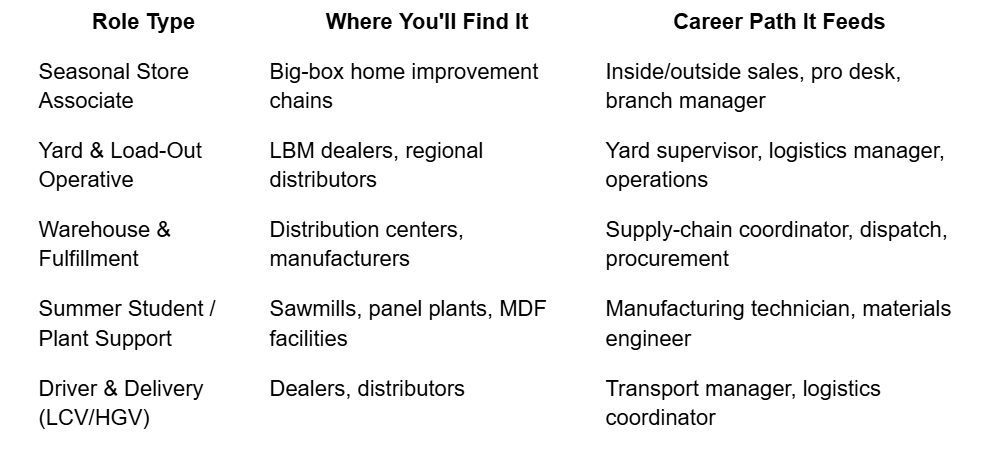
The big-box home improvement chains are the most visible employers, with seasonal associate roles in lumber, building materials, garden, and millwork departments scaling up from April through August. These roles emphasize customer service, project consultation, and cross-department learning, not merely stocking shelves. An associate who learns to guide a contractor through a full framing package, or who can confidently navigate the roofing aisle for a homeowner tackling a first reroofing project, is learning consultative selling. That skill, refined, is what drives the highest-earning outside sales roles in the industry.
Lumber and Building-Materials Manufacturing
Forest-products companies advertise structured summer-student roles in sawmills, panel plants, and MDF facilities, typically running May through September. These positions involve sorting, stacking, yard operations, equipment operation, and plant support—work that sounds industrial but provides direct exposure to how raw materials become finished products. Manufacturers who offer these programs often frame them explicitly around career progression, and many candidates who pass through a mill summer find themselves with an informed sense of supply-side economics that desk-bound peers simply don't have.
Distribution Centers and Logistics Roles
Behind every successful dealer is a distribution network that keeps product moving. Warehousing and logistics roles—order fulfillment, inventory handling, freight coordination, dispatching—expand with summer volume and are increasingly structured as formal summer contracts or internships. These roles offer exposure to routing, scheduling, and the supply-chain mechanics that govern how materials reach jobsites. They also map directly onto some of the most in-demand full-time careers in building materials: supply-chain coordination, branch operations, and dispatch management.
Why Summer Roles Have Outsized Career Impact
Let's be specific about why this matters beyond the résumé line. The daily work of a yard operative, the loading trucks, verifying order tickets, managing substitutions when stock runs short, is a direct rehearsal of the core activities in higher-paying logistics and branch-operations careers. There is no abstraction here. You are doing the thing, at volume, under pressure, in real time.
Summer is also when you see the real demand picture. Peak loads surface stock-outs, backorders, and rush orders. They reveal how a distributor actually responds to volatility, which customer segments (production builders, remodelers, industrial buyers) drive resilience when things get difficult. The patterns in which SKUs move (framing packages, roofing materials, windows, insulation) offer a direct readout of local housing and renovation trends that no economic report gives you faster.
Those who pay attention to these patterns are, in a meaningful sense, becoming economic forecasters. The volume and mix of orders, the frequency of price adjustments, the shifting lead times: front-line seasonal staff handle the highest-resolution demand data in the building-materials ecosystem. The market speaks through the yard, and summer is when it speaks loudest.
Rethinking Entry-Level: Summer as a Live-Action Career Lab
Here's the reframe worth thinking about: you are not taking a summer job. You are running a live experiment in how the material economy behaves where you live.
A branch yard is not a classroom, but it teaches things no classroom offers, including how branches prioritize deliveries when three contractors show up at once, which product lines command margin, how experienced counter staff read a customer's confidence level and adjust accordingly. This is applied operations, with real consequences when a truck is late or a customer walks.
Workers who deliberately capture what they observe build pattern recognition that is genuinely useful for future roles in purchasing, inventory management, and sales. "I helped reduce loading delays by reorganizing high-turn products near the staging area" is not a minor bullet point. It is the kind of concrete, process-improvement story that separates candidates in any interview for a building-materials operations role.
Employers, for their part, tend to undervalue what seasonal workers actually see and process. The paradox is that the person loading the flatbed at 7 a.m. handles more transactions per hour at peak than most desk roles do in a day. Job seekers who recognize this, and are able to frame their experience accordingly, present themselves as rare, insight-generating entry talent rather than warm bodies filling a summer gap.
Employer Cycles and How to Time Your Job Search
Timing is where many candidates leave value on the table. Seasonal hiring typically opens from early spring onward and many roles are defined as under six months to match project and weather cycles, but the competition thins dramatically for applicants who move early. A candidate who applies in late February or early March, when postings are just beginning to appear, is not competing against the June rush.
The practical calendar runs like this: watch for job postings from large chains and regional dealers starting in February. Apply 8 to 12 weeks before local building season peaks in your area. Watch street-level signals such as rising yard stock at your local dealer, extended store hours, new racks going in, contractor-event advertising, etc., as confirmation that staffing is about to scale. These are not subtle signs. They are the industry announcing, in physical form, that summer has arrived for them before it has arrived for the calendar.
For candidates in high-growth regions (Sun Belt markets, suburban Southeast, Mountain West) local hotspots may be staffing even when national starts plateau. Targeting employers in those areas, or targeting specialty segments like roofing supply or HVAC distribution that track renovation rather than new construction, can open doors that a national headline might suggest are closed.
Skills That Get You Hired (and Rehired)Every Summer
Physical stamina and comfort with hands-on work are explicit prerequisites in most yard and warehouse postings. The work involves lifting, loading, and operating in variable temperatures, and employers are not shy about saying so. Candidates who arrive with an honest understanding of the physical demands and a demonstrated history of work that required them, move faster in screening.
Customer-facing communication is the other consistent ask, particularly for retail and counter roles. The ability to ask open-ended questions about a customer's project, to navigate a conversation from "I need drywall" to a full materials list, and to remain helpful under pressure when inventory is short: these are skills that travel. They are the same core competencies that define consultative sales at every level of the industry.
On the safety front, credentials matter more than many entry-level candidates realize. Candidates who arrive with WHMIS certification (for Canada-based roles), basic forklift training, or fall-protection awareness often move into higher-responsibility yard or warehouse roles faster than peers without those credentials.
The underlying skill that threads all of this together, and the one that compounds into promotions, is understanding flow: how product, paperwork, and people move through a branch from inbound trucks to storage to picking to loading. Candidates who can articulate, with specifics, how they helped reduce friction at any step of that flow are presenting themselves as operationally literate. That literacy is exactly what branch managers are looking for when inside-sales and dispatch positions open.
Positioning Yourself as Next-Season Ready
The end of summer is not the end of the play. It is the setup for the next one. Seasonal workers who close the season with a clear, documented record of their impact on loads prepared per shift, error rates, wait-time improvements, safety contributions, have the raw material for a strong return pitch. Translate those metrics into résumé bullets focused on process improvement, reliability, and learning speed, and a summer role starts reading less like temporary work and more like an operational apprenticeship.
Building an internal advocate matters as much as building a record. Identify a supervisor or senior associate who can speak to your performance. Ask explicitly, what it would take to be invited back or moved into a part-time or full-time capacity. Stay in light contact through the off-season: a message sharing updated certifications or confirming availability for the next spring is a low-effort, high-signal move that most candidates skip entirely.
The multi-season game is where this strategy really compounds. Two or three consecutive summers at the same dealer or distributor (cycling through yard, counter, scheduling, and inside sales within a single employer) begin to resemble a rotational program on a résumé. That continuity reads as focused industry experience rather than a series of unrelated seasonal stints, and it is exactly the kind of background that branch managers and regional operators watch for when they are building future leadership from within.
Turning Seasonal Roles into Year-Round Offers
The full-time roles in building materials that are hardest to fill in 2025 and into 2026 cluster around supply chain, branch-level operations leadership, and technical sales. Labor shortages, industry consolidation, and rising automation have all tightened the talent market in these functions. The seasonal roles that sit closest to them, such as yard lead, inventory assistant, pro-desk associate and driver, are natural stepping stones and employers know it.
The conversion move is deliberate visibility. Volunteer for tasks that mirror full-time responsibilities: closing duties, inventory counts, routing calls, customer-issue resolution. Request cross-training—a yard worker asking to shadow inside sales for a morning is not an imposition; it is an initiative that supervisors notice. Presenting a simple, informal case for off-season value, even over a casual conversation, is enough to plant the idea that you are not just a summer hire but a candidate for something more.
Some employers make this explicit. Co-op and structured summer programs at manufacturers and larger dealers sometimes tie summer terms to eligibility for full-time offers or signing incentives. Students in these programs earn both pay and credit, building a stronger case for apprenticeship or entry-professional transitions. Even outside formal programs, the candidate who has three summers with the same employer and a clear operational track record walks into a full-time conversation from a position of genuine leverage.
Action Playbooks
For Students and Early-Career Job Seekers
- Target home improvement chains, regional LBM dealers, forest-products companies, and building-materials manufacturers advertising summer-student, seasonal associate, or operations intern roles.
- Complete basic safety and job-readiness credentials where accessible (WHMIS, forklift awareness, co-op program safety modules) before your first day.
- Apply early: February to March for spring-opening roles. Follow up in person where appropriate. Walk the yard or department you want to work in and use what you observe as a conversation starter.
- Keep a running log of what moves through your branch: which product lines spike, which slow, which suppliers deliver reliably. This is the raw material of your next interview story.
For Career Changers from Retail, Logistics, or Trades
- Position your existing experience directly: inventory turns, shrink control, dock management, customer problem-solving, and warehouse operations are the same competencies building-materials employers value—use the language they use.
- Learn the product vocabulary before your first interview: framing versus finish, structural versus decorative, commodity versus specialty. Employer websites and manufacturer resources are free.
- Apply for roles that emphasize operations, inventory, and pro-customer contact. Frame your objective explicitly: transitioning into year-round building-materials operations or sales within 12 to 24 months.
- Use your background in trades or logistics to ask sharper questions in interviews. Candidates who demonstrate they already understand how material moves earn trust faster.
Signals to Watch: Housing, Remodeling, and Dealer Activity
The macro picture matters, but the street-level signals are often sharper and faster. Housing-start projections, regional renovation indices, and local construction outlooks are leading indicators for material demand and for branch-level hiring. Familiarize yourself with your region's trends. A metropolitan area with sustained population growth and constrained housing inventory will keep dealers and distributors staffed at a higher baseline than a flat-growth market.
On the ground: rising yard stock, new shelving going in, expanded store hours, contractor-event promotions, and dealer advertising for credit and delivery services are all signs that volume is building and staffing will follow. Watch the pro parking lot at your local home center on a Tuesday morning. If it's full of contractor vans at 6:30 a.m., the dealer is busy. If the dealer is busy, they are hiring.
Building-materials professionals who treat every summer as an opportunity to decode local demand patterns—who track what moves through the yard, which lines are back-ordered, when lead times lengthen—develop the ability to anticipate where jobs will open next season more reliably than any headline economic report. That forecasting ability is not incidental. It is the core skill of a supply-chain professional, a branch operations manager, or a regional sales lead. You can start developing it at 19, on a seasonal wage, if you pay attention.
Conclusion: Designing a Career Around Seasonal Demand
The building materials industry is, at its core, a bet on the permanence of human shelter. Homes will be built, renovated, and upgraded. Roads and infrastructure will require maintenance. The materials behind all of it, the roofing, insulation, plumbing, flooring, smart systems, glass, and composites, will need to be designed, produced, distributed, and sold by people who understand both the products and the market. That work is not glamorous in the way that tech startups are glamorous. But it is durable, skilled, and increasingly well-compensated, especially at the operations and sales levels where experienced talent is hardest to find.
Summer is the door that opens widest, and earliest. A seasonal role at a regional dealer, a forest-products manufacturer, or a distribution center is not a detour from a serious career path. Approached with intention and timed well, performed with deliberate effort, and parlayed through relationship-building and explicit positioning is the path. The industry is hiring now. The question is only whether you arrive with a paycheque in mind or a career.
Frequently Asked Questions
What kinds of jobs are available in the building materials industry? The range is wider than most job seekers expect. Roles span yard and counter operations, inside and outside sales, warehousing and logistics, delivery driving (LCV and HGV), product manufacturing, materials engineering, sustainability, digital marketing, e-commerce, and branch management. The industry covers everything from sawmills and panel plants to plumbing-supply distributors to smart-home technology retailers.
How is building materials different from working in construction? Building materials roles are based inside manufacturers, dealers, distributors, and retailers—not on the jobsite itself. The work focuses on producing, moving, selling, and supporting the products that construction crews use, rather than the physical installation of those products. The environments, skill sets, and career ladders are distinct, though knowledge of construction processes is an asset in sales and product roles.
What entry-level roles can I start with, and do I need a degree? Most entry points—yard operative, seasonal store associate, warehouse and fulfillment roles, plant support positions—require no post-secondary credential. Physical fitness, reliability, and a willingness to learn product knowledge are the primary prerequisites. Many employers offer on-the-job training, and safety certifications like WHMIS or forklift licensing can accelerate progression. Degrees and diplomas become relevant at engineering, sustainability, and corporate-function levels, but the field has strong trade-based and on-the-job pathways at every level below that.
What skills matter most for building materials careers? Physical stamina for yard and warehouse roles; customer-facing communication and project-consultation ability for retail and counter positions; and an aptitude for understanding how product, information, and people flow through a branch or distribution facility. Safety literacy, product knowledge, and the ability to work under the pressure of peak-season volumes are consistently valued. At more senior levels, analytical thinking, pricing judgment, and relationship management with contractor and pro customers become central.
Can I move into building materials from retail, logistics, or the trades? Yes, and the transition is more direct than many career changers assume. Inventory management, dock operations, customer service under pressure, and shrink control all translate cleanly. Tradespeople bring product knowledge that is immediately useful in counter-sales and technical-sales roles. The adjustment is primarily one of vocabulary and industry orientation, both of which are learnable before a first interview.
What does a building materials sales representative do day to day? Inside sales representatives handle inbound inquiries, quote preparation, order management, and customer-relationship maintenance—often working closely with contractors, builders, and remodelers to ensure they have the right product at the right time. Outside sales representatives make proactive calls on accounts, develop new business, and serve as the face of the company in their territory. Both roles require strong product knowledge, responsiveness, and an ability to solve problems quickly when supply constraints arise.
What is a yard operative, and what does the role involve? A yard operative manages the physical flow of materials in a dealer yard or distribution facility—receiving inbound loads, organizing stock, pulling and staging customer orders, loading outbound trucks, and maintaining yard safety and organization. It is physically demanding work that requires product familiarity, attention to detail, and the ability to keep pace with high transaction volumes during peak season. It is also, as described throughout this article, one of the most informative vantage points in the entire supply chain.
Are there careers in sustainability and green building materials? Growing ones. ESG and sustainability roles within building-products manufacturers are expanding as regulatory pressure and consumer demand for lower-embodied-carbon products increase. Sustainability specialists, environmental compliance leads, and R&D roles focused on composites, laminates, and advanced materials are all active functions at larger manufacturers. Green building product lines—low-VOC finishes, reclaimed materials, high-performance insulation—also require marketing, technical sales, and education roles as they scale.
How much can I earn in building materials at entry, mid, and senior levels? Earnings vary significantly by role, region, and employer size. Entry-level yard and warehouse roles in Canada and the United States typically range from minimum wage to the low-to-mid twenties per hour depending on location and employer. Inside sales and counter roles with experience often range from $45,000 to $65,000 annually. Outside sales and branch management roles regularly reach $75,000 to well over $100,000 with commissions and performance bonuses included. Supply-chain, engineering, and corporate function roles vary widely by credential and employer.
Where can I find reliable job listings for building materials careers? Start with the career pages of large home improvement retailers and regional LBM dealer associations in your province or state. National job boards (Indeed, LinkedIn, Workopolis in Canada) surface roles from major employers. Forest-products companies and building-products manufacturers post summer-student and intern roles directly. Trade associations such as the National Lumber and Building Material Dealers Association (NLBMDA) in the United States and regional equivalents in Canada can also point to member-company career resources.